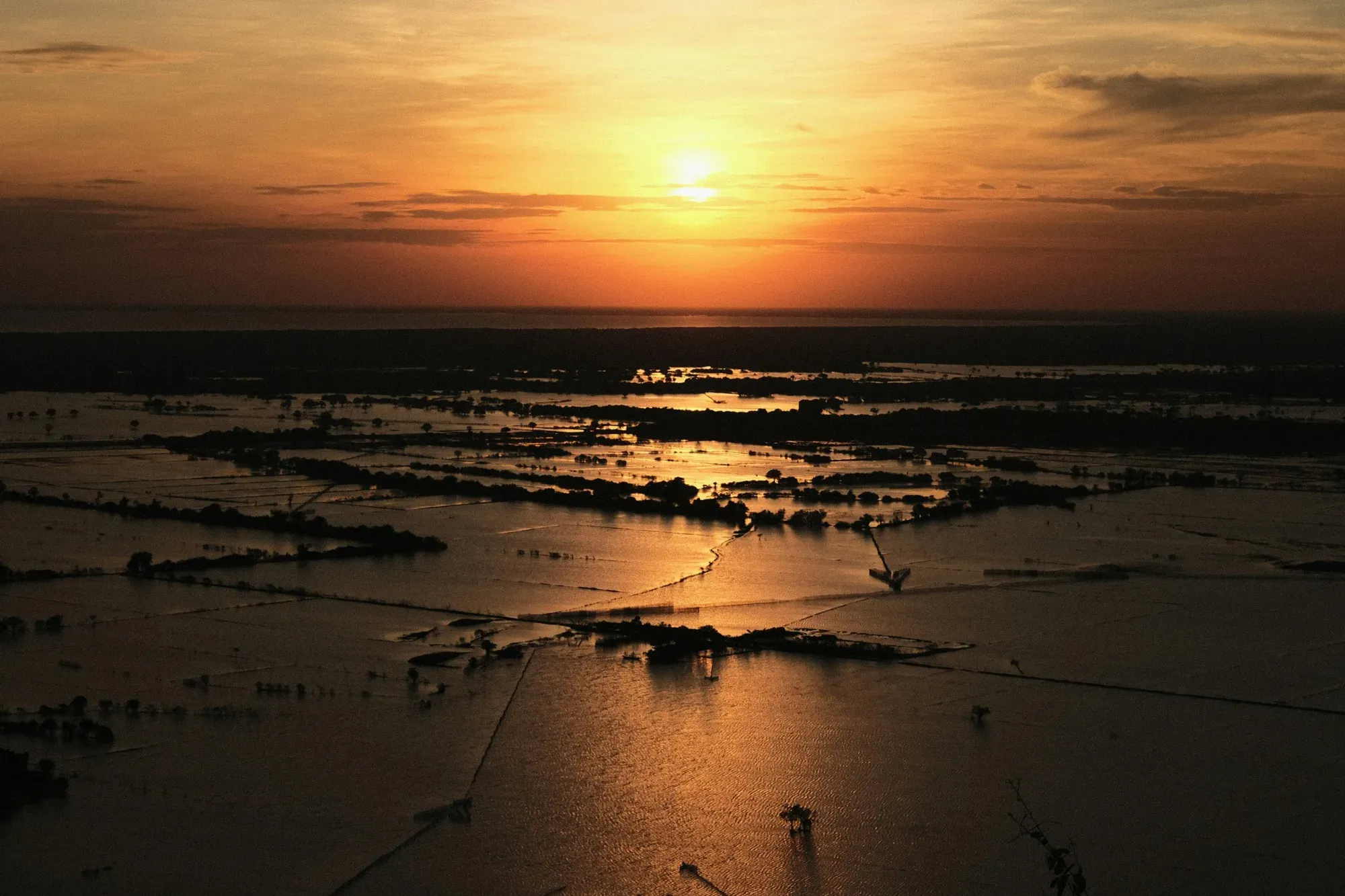
Tonle Sap is the largest freshwater lake in Southeast Asia, a UNESCO biosphere reserve, and the reason Cambodia has had rice and fish for two thousand years. Every monsoon the Mekong forces the Tonle Sap River to flow backwards, and the lake grows five times over. More than a million people live on and around it, in villages that float, stand on stilts, or do both depending on the month.
- Dry season size
- About 2,500 km², 1 m deep
- Wet season size
- Over 12,000 km², 9 m deep
- River reverses
- June to October
- People on the lake
- More than a million
- Fish catch
- About 60% of Cambodia's protein
- From Siem Reap
- 15 to 50 km
How the lake works
The Tonle Sap River connects the lake to the Mekong at Phnom Penh. For most of the year it drains the lake south. When the monsoon swells the Mekong faster than the delta can carry it away, the river backs up and turns around, pushing Mekong water, silt and fish eggs north into the lake. The lake rises by eight metres, drowns the forest around its shore, and becomes the biggest fish nursery in the world. In November the Mekong drops, the river turns south again, and the Water Festival in Phnom Penh marks the moment.

The lake, month by month
What you see depends more on the month than on the village. The table is how our guides describe each one; sunset times are for Siem Reap.
| Month | Water | Villages | Canoe | Sunset | Light |
|---|---|---|---|---|---|
| January | high, dropping | floating | Running | 17:50 | clear skies, warm gold at sunset |
| February | dropping | stilts showing | No | 18:05 | dry, hazy afternoons |
| March | low | on stilts | No | 18:12 | hot, hazy |
| April | lowest | on stilts | No | 18:15 | hot, hazy |
| May | low, first rains | on stilts | No | 18:20 | big clouds, dramatic sunsets |
| June | rising | on stilts | No | 18:28 | green countryside, afternoon showers |
| July | rising fast | water at the stilts | Running | 18:30 | lush, stormy skies |
| August | high | floating | Running | 18:20 | lush, stormy skies |
| September | high | floating | Running | 18:03 | clearing, soft light |
| October | highest | floating | Running | 17:45 | clear, best of the year |
| November | high, Water Festival | floating | Running | 17:35 | clear, cool evenings |
| December | high, dropping | floating | Running | 17:38 | clear, cool evenings |


Left, October. Right, April. Same village.
Who lives on the lake
Fishing families, mostly Khmer with Vietnamese and Cham communities in the houseboat villages. The catch feeds the country; the fish paste, prahok, that flavours Cambodian cooking comes from here. In the dry season many families farm the land the water leaves behind. Children paddle to school. Pagodas, markets and clinics stand on stilts or float. It is a working landscape, and the villages that do best are the ones where tourism is a side income rather than the main one.


The villages
Four villages near Siem Reap take visitors: Kompong Phluk, Kompong Khleang, Mechrey and Chong Kneas. They differ in distance, crowds, price and what you actually see. Our comparison is the place to choose; the short version is Phluk for the flooded forest, Khleang for authenticity, Mechrey for quiet, and Chong Kneas only if you have an hour.
What it costs
Community boat tickets are USD 20 per person at Kompong Phluk, Kompong Khleang and Mechrey; Chong Kneas is USD 7 with a four-ticket minimum. Canoes and the bird sanctuary are USD 5 to 10 extra. Our group tours are $28 and $32 with everything included; a private day starts at $75. Every fee, village by village.
See it with someone who lives there
Our guides were born in Kompong Phluk and Kompong Khleang. The tours use the community boats and pay the community price. Join the daily sunset tour, or tell the builder what matters to you and assemble your own afternoon.

Frequently asked questions
Where is Tonle Sap Lake?
In the centre of Cambodia, south of Siem Reap and north of Phnom Penh. The nearest shore to Siem Reap is 15 km away at Chong Kneas; the villages worth visiting are 30 to 50 km from town.
Why does the Tonle Sap River reverse?
In the monsoon the Mekong rises faster than the lake can drain, so water is pushed back up the Tonle Sap River into the lake. From roughly June to October the river flows north; when the Mekong drops, it turns around and flows south again.
How big does the lake get?
From about 2,500 square kilometres and a metre deep in April to over 12,000 square kilometres and nine metres deep in October. The forest around it floods for months.
Can you swim in Tonle Sap?
Locals do; we don't recommend it for visitors. The water is silty, there are nets and stakes everywhere, and the villages use the lake for everything.
Is a Tonle Sap tour worth it?
If you choose the right village and go with someone from it, yes. Kompong Phluk or Kompong Khleang, in high water, at sunset, with a guide who grew up there. A fifteen-minute hop to Chong Kneas is the version people regret.